Composition Root
# entity
class Order
attr_reader :id, :total
def initialize(id, total)
@id = id
@total = total
end
def payable
total >= 200 ? total - total / 10 : total
end
end
# gateway
module Catalog
def price(sku)
raise NotImplementedError, "#{self.class}#price"
end
end
# repository
module Orders
def save(order)
raise NotImplementedError, "#{self.class}#save"
end
def count
raise NotImplementedError, "#{self.class}#count"
end
end
# output port
module Report
def say(text)
raise NotImplementedError, "#{self.class}#say"
end
end
# use case: asks for its parts, never builds them
class PlaceOrder
def initialize(catalog, orders, report)
@catalog = catalog
@orders = orders
@report = report
@next_id = 1001
end
def place(items)
total = 0
items.each do |sku, count|
price = @catalog.price(sku)
unless price
@report.say("no #{sku}")
return
end
total += price * count
end
order = Order.new(@next_id, total)
@next_id += 1
@orders.save(order)
text = "order #{order.id} for #{order.payable}"
@report.say(text)
end
end
# adapters
class MemoryCatalog
include Catalog
def price(sku) = {"pen" => 30, "lamp" => 190}[sku]
end
class MemoryOrders
include Orders
def initialize
@rows = []
end
def save(order) = @rows << order
def count = @rows.size
end
class ConsoleReport
include Report
def say(text) = puts(text)
end
class SilentReport
include Report
def say(text) = nil
end
# composition root: the only place that sees every layer
# at once, and the only place where an adapter is built.
# the two ready builds are class methods, because the
# root also hands out the parts it has put together
class ShopApp
attr_reader :use_case, :orders
def initialize(catalog, orders, report)
@orders = orders
@use_case = PlaceOrder.new(catalog, orders, report)
end
def self.loud
new(MemoryCatalog.new, MemoryOrders.new,
ConsoleReport.new)
end
def self.quiet
new(MemoryCatalog.new, MemoryOrders.new,
SilentReport.new)
end
end
# client code
app = ShopApp.loud
app.use_case.place({"pen" => 2, "lamp" => 1})
app.use_case.place({"chair" => 1})
puts "saved #{app.orders.count}"
# a second root builds the same use case differently,
# and neither the scenario nor the entity knows it
night = ShopApp.quiet
night.use_case.place({"lamp" => 1})
night.use_case.place({"pen" => 2})
puts "saved at night #{night.orders.count}"
# no adapter is built outside the root: the client asks
# for a ready application and gets one, and the scenario
# it got is the same class in both builds
puts "use case #{app.use_case.class}"
same = app.use_case.class == night.use_case.class
puts "same class #{same}"
# printed: order 1001 for 225
# no chair
# saved 1
# saved at night 2
# use case PlaceOrder
# same class true
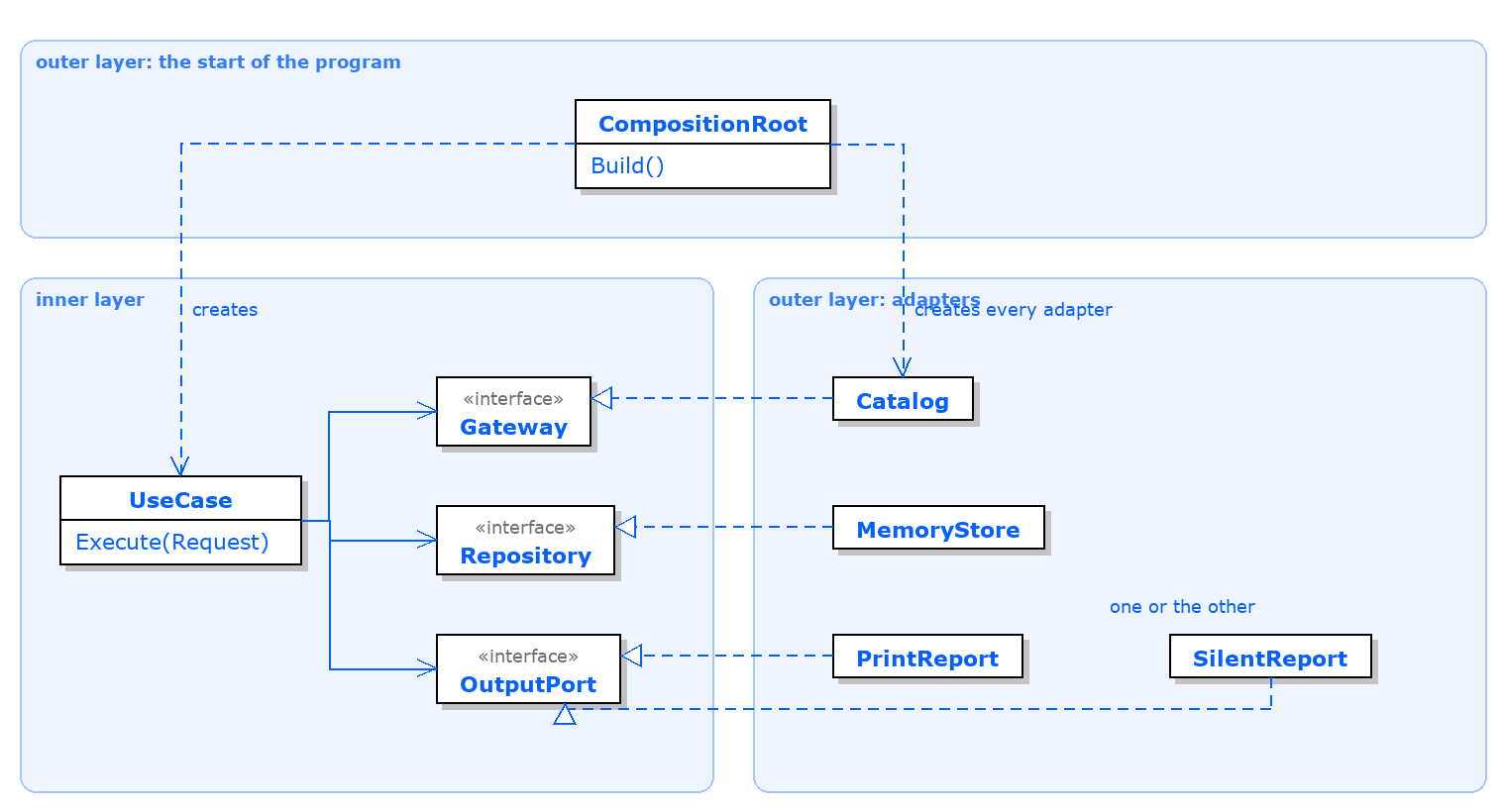
A composition root is the only place where the layers are connected and the adapters are built; the rest of the application only asks for its parts.Read moreThe problem. A use case needs a catalogue of prices, a store for orders and a way to report. If the use case creates these parts itself, it names adapters of the outer layer and depends on them. A test cannot give it other parts. If every part of the program builds its own parts, nobody sees how the application is connected. The idea. A composition root is the only place where the layers are connected and the adapters are built. An adapter is outer code that implements a port, the interface that the inner layer declares. The use case only asks for its parts through ports and never builds them. The root knows every layer at once, and that is its job. All other code keeps the dependency rule: inner code never knows outer code. No framework or container is needed: the root is plain code at the start of the program. How to read the example. The use case asks for three ports: a gateway for prices, a repository for orders and an output port for reports. The outer layer has adapters for them: a catalogue and a store in memory, a report that prints and a report that says nothing. The example builds the application twice. In the first build the report prints: the client code places order 1001, with 225 to pay, and an order for an unknown item. The second build has the silent report, so its orders print nothing. Only the count of saved orders shows that they were saved. The use case is the same in both builds. When to use it. Every application has one composition root, at its start; a test may have its own small root with fake adapters. A short script without ports needs no root. A common mistake. Creating an adapter inside a use case, even once. The use case then depends on the outer layer, and the root no longer shows how the application is connected. |