代理
<?php
//Subject
abstract class Graphic {
protected $fileName = "";
abstract function draw();
function getFileName(): string {
return $this->fileName;
}
}
//RealSubject
class Image extends Graphic {
function __construct(string $fileName) {
$this->fileName = $fileName;
}
//Request()
function draw() {
echo "draw " . $this->fileName, "\n";
}
}
//Proxy
class ImageProxy extends Graphic {
private $image = null;
function __construct(string $fileName) {
$this->fileName = $fileName;
}
function draw() {
$this->getImage()->draw();
}
function getImage(): Image {
if ($this->image == null) {
$this->image = new Image($this->fileName);
}
return $this->image;
}
}
//Client
$proxy = new ImageProxy("1.png");
//operation without creating a RealSubject
$fileName = $proxy->getFileName();
//forwarded to the RealSubject
$proxy->draw();
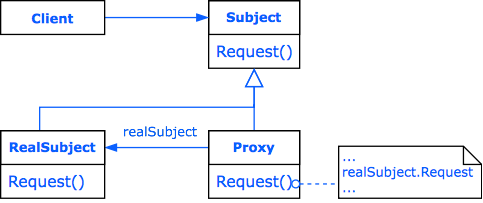
Provide a surrogate or placeholder for another object to control access to it. The proxy implements the interface of the original object.Read more问题。一份文档包含许多大图。如果程序在打开文档时就加载所有图片,打开会很慢,尽管用户只看到第一页。显示图片的代码应当保持不变,但加载必须推迟到真正需要某张图片时。 思路。代理代替另一个对象,即真实对象。两者接口相同,因此客户端看不出它们的区别。代理决定何时以及如何使用真实对象。这里的代理属于虚拟代理:它只在第一次请求时创建真实对象,之后把每次调用都转发给它。其他种类的代理会检查访问权限、维护缓存,或者访问另一台计算机上的对象。 如何阅读示例。真实对象是一张创建代价高昂的图像。代理只保存文件名,并为图像留出一个空位。在大多数语言中,客户端先询问文件名,代理自己就能回答。当客户端要求绘制时,代理创建真实的图像,保存下来并转发这次调用。客户端始终只与代理打交道。在某些语言中,输出还会显示真实图像被加载的时刻。 何时使用。要控制对某个对象的访问、又不改变该对象及其客户端时,使用代理模式。典型的任务有:推迟代价高昂的创建、检查权限、统计调用次数。对象创建代价低廉而且总是需要时,不要使用它:多出的一层只会拖慢代码。 常见错误。没有保存已创建的对象。这样代理每次调用都会创建一个新的真实对象,节省也就无从谈起。 |