组合根
//entity
@interface Order : NSObject
@property (nonatomic, readonly) NSInteger number;
@property (nonatomic, readonly) NSInteger total;
@property (nonatomic, readonly) NSInteger payable;
- (instancetype)initWithNumber:(NSInteger)number
total:(NSInteger)total;
@end
@implementation Order
- (instancetype)initWithNumber:(NSInteger)number
total:(NSInteger)total {
self = [super init];
if (self) {
_number = number;
_total = total;
}
return self;
}
- (NSInteger)payable {
return _total >= 200 ? _total - _total / 10 : _total;
}
@end
//gateway
@protocol Catalog <NSObject>
- (NSNumber *)priceOf:(NSString *)sku;
@end
//repository
@protocol Orders <NSObject>
- (void)save:(Order *)order;
- (NSUInteger)count;
@end
//output port: one job, so a block type
typedef void (^Report)(NSString *text);
//use case: asks for its parts, never builds them; they
//come in as properties, the way Cocoa wires outlets and
//delegates, and one forgotten would stay nil, silently:
//another reason to set them in exactly one place
@interface PlaceOrder : NSObject
@property (nonatomic, strong) id<Catalog> catalog;
@property (nonatomic, strong) id<Orders> orders;
@property (nonatomic, copy) Report report;
//a dictionary is fine here: only the sum is seen, never
//the order in which the lines were walked
- (void)place:(NSDictionary *)items;
@end
@implementation PlaceOrder
- (void)place:(NSDictionary *)items {
NSInteger total = 0;
for (NSString *sku in items) {
NSNumber *price = [self.catalog priceOf:sku];
if (price == nil) {
self.report([@"no "
stringByAppendingString:sku]);
return;
}
total += price.integerValue
* [items[sku] integerValue];
}
Order *order = [[Order alloc]
initWithNumber:1001 + self.orders.count
total:total];
[self.orders save:order];
self.report([NSString stringWithFormat:
@"order %ld for %ld", (long)order.number,
(long)order.payable]);
}
@end
//adapters
@interface MemoryCatalog : NSObject <Catalog>
@end
@implementation MemoryCatalog
- (NSNumber *)priceOf:(NSString *)sku {
return @{@"pen": @30, @"lamp": @190}[sku];
}
@end
@interface MemoryOrders : NSObject <Orders>
@end
@implementation MemoryOrders {
NSArray<Order *> *_rows;
}
- (void)save:(Order *)order {
NSArray *before = _rows ? _rows : @[];
_rows = [before arrayByAddingObject:order];
}
- (NSUInteger)count {
return _rows.count;
}
@end
//composition root: the only place that sees every layer
//at once, and the only place where an adapter is built;
//no NSClassFromString and no list of class names in a
//plist: the runtime could wire the app by strings, and
//the compiler would check none of it
@interface ShopApp : NSObject
@property (nonatomic, strong, readonly) PlaceOrder *useCase;
@property (nonatomic, strong, readonly) id<Orders> orders;
+ (instancetype)loudApp;
+ (instancetype)quietApp;
@end
@implementation ShopApp
- (instancetype)initWithReport:(Report)report {
self = [super init];
if (self) {
_orders = [[MemoryOrders alloc] init];
_useCase = [[PlaceOrder alloc] init];
_useCase.catalog = [[MemoryCatalog alloc] init];
_useCase.orders = _orders;
_useCase.report = report;
}
return self;
}
+ (instancetype)loudApp {
return [[ShopApp alloc] initWithReport:
^(NSString *text) { NSLog(@"%@", text); }];
}
//a report that says nothing ignores the text, and says
//so with (void): Apple's __unused is missing on GNUstep
+ (instancetype)quietApp {
return [[ShopApp alloc] initWithReport:
^(NSString *text) { (void)text; }];
}
@end
//client code
ShopApp *app = [ShopApp loudApp];
[app.useCase place:@{@"pen": @2, @"lamp": @1}];
[app.useCase place:@{@"chair": @1}];
//a second root builds the same use case differently
ShopApp *night = [ShopApp quietApp];
[night.useCase place:@{@"lamp": @1}];
NSLog(@"saved %lu", (unsigned long)night.orders.count);
//printed: order 1001 for 225
// no chair
// saved 1
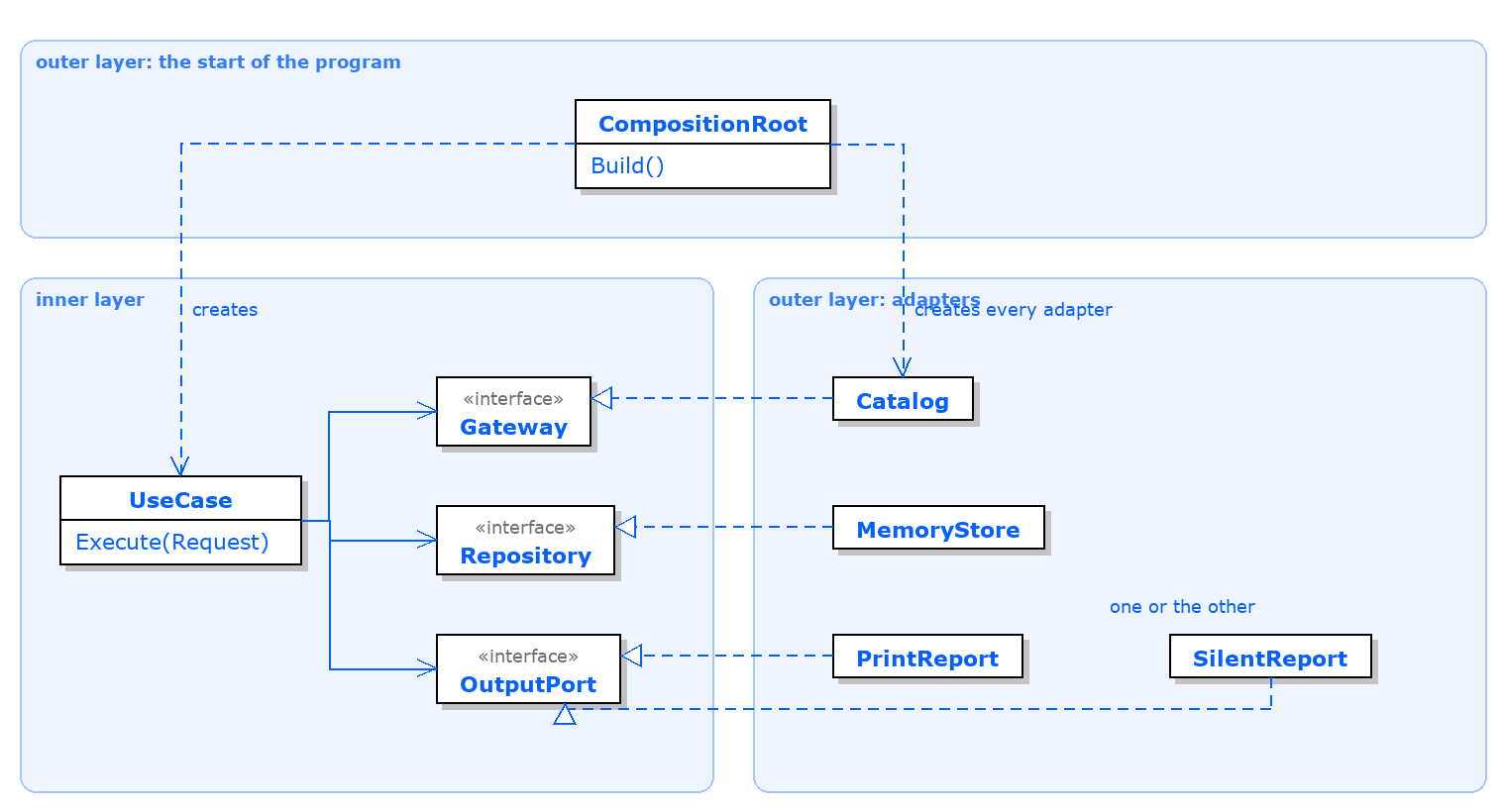
A composition root is the only place where the layers are connected and the adapters are built; the rest of the application only asks for its parts.Read more问题。用例需要一个价格目录、一个订单存储,以及一种报告结果的途径。如果用例自己创建这些部件,它就会指明外层的适配器,并依赖于它们。测试也无法为它提供别的部件。如果程序的每个部分都自行构建自己的部件,就没有人能看清应用程序是如何连接起来的。 思路。组合根是唯一一个连接各层、构建适配器的地方。适配器是实现端口的外层代码,而端口是内层声明的接口。用例只通过端口索取自己的部件,从不自己构建它们。组合根同时了解每一层,这正是它的职责。其余所有代码都遵守依赖规则:内层代码从不了解外层代码。这不需要任何框架或容器:组合根就是程序启动处的普通代码。 如何阅读示例。用例索取三个端口:一个查询价格的网关、一个保存订单的仓库,以及一个用于报告的输出端口。外层为它们提供了适配器:内存中的目录和存储,一个会打印的报告,还有一个什么也不说的报告。示例把应用程序构建了两次。第一次构建中,报告会打印:客户端代码下了订单 1001,应付 225,又下了一个含未知商品的订单。第二次构建使用静默的报告,因此它的订单什么也不打印。只有已保存订单的数量表明它们确实被保存了。两次构建中的用例完全相同。 何时使用。每个应用程序都有一个组合根,位于它的启动处;测试可以有自己的小型组合根,使用假的适配器。没有端口的短脚本不需要组合根。 常见错误。在用例内部创建适配器,哪怕只有一次。这样用例就依赖于外层,组合根也不再能展示应用程序是如何连接起来的。 |