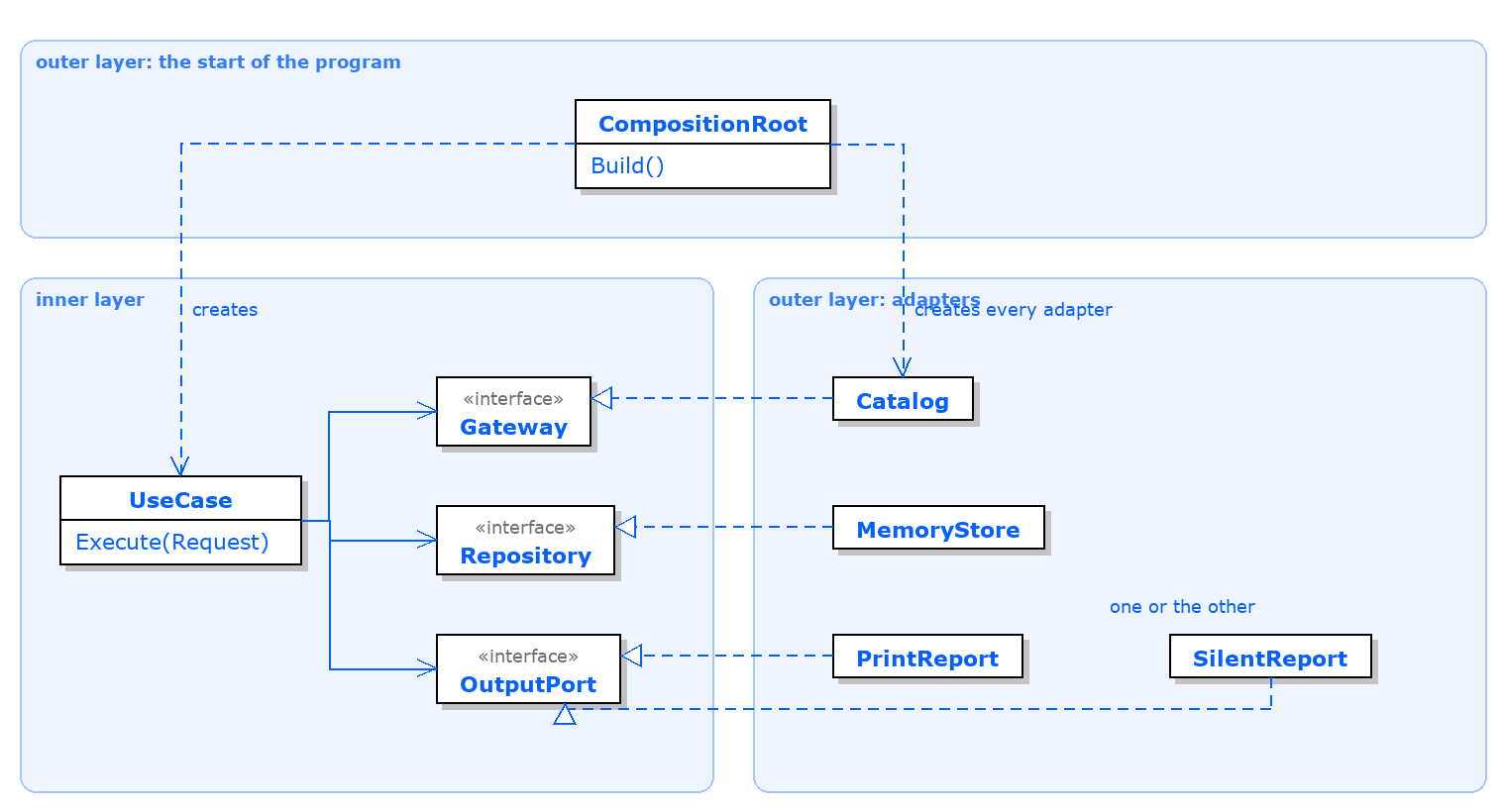
组合根
from typing import Protocol
# entity
class Order:
def __init__(self, id: int, total: int):
self.id = id
self.total = total
@property
def payable(self) -> int:
if self.total < 200:
return self.total
return self.total - self.total // 10
# gateway
class Catalog(Protocol):
def price(self, sku: str) -> int | None: ...
# repository
class Orders(Protocol):
def save(self, order: Order) -> None: ...
def count(self) -> int: ...
# output port
class Report(Protocol):
def say(self, text: str) -> None: ...
# use case: asks for its parts, never builds them
class PlaceOrder:
def __init__(self, catalog: Catalog, orders: Orders,
report: Report):
self._catalog = catalog
self._orders = orders
self._report = report
self._next_id = 1001
def place(self, items: dict[str, int]) -> None:
total = 0
for sku, count in items.items():
price = self._catalog.price(sku)
if price is None:
self._report.say(f"no {sku}")
return
total += price * count
order = Order(self._next_id, total)
self._next_id += 1
self._orders.save(order)
self._report.say(
f"order {order.id} for {order.payable}")
# adapters
class MemoryCatalog:
def price(self, sku: str) -> int | None:
return {"pen": 30, "lamp": 190}.get(sku)
class MemoryOrders:
def __init__(self):
self._rows: list[Order] = []
def save(self, order: Order) -> None:
self._rows.append(order)
def count(self) -> int:
return len(self._rows)
class ConsoleReport:
def say(self, text: str) -> None:
print(text)
class SilentReport:
def say(self, text: str) -> None:
pass
# composition root: the only place that sees every
# layer at once, and the only place where an adapter is
# built. the two ready builds are classmethods, because
# the root also hands out the parts it has put together
class ShopApp:
def __init__(self, catalog: Catalog, orders: Orders,
report: Report):
self.orders = orders
self.use_case = PlaceOrder(catalog, orders, report)
@classmethod
def loud(cls) -> "ShopApp":
return cls(MemoryCatalog(), MemoryOrders(),
ConsoleReport())
@classmethod
def quiet(cls) -> "ShopApp":
return cls(MemoryCatalog(), MemoryOrders(),
SilentReport())
# client code
app = ShopApp.loud()
app.use_case.place({"pen": 2, "lamp": 1})
app.use_case.place({"chair": 1})
print("saved", app.orders.count())
# a second root builds the same use case differently,
# and neither the scenario nor the entity knows it
night = ShopApp.quiet()
night.use_case.place({"lamp": 1})
night.use_case.place({"pen": 2})
print("saved at night", night.orders.count())
# no adapter is built outside the root: the client
# asks for a ready application and gets one, and the
# scenario it got is the same class in both builds
print("use case", type(app.use_case).__name__)
print("same class",
type(app.use_case) is type(night.use_case))
# printed: order 1001 for 225
# no chair
# saved 1
# saved at night 2
# use case PlaceOrder
# same class True
A composition root is the only place where the layers are connected and the adapters are built; the rest of the application only asks for its parts.Read more问题。用例需要一个价格目录、一个订单存储,以及一种报告结果的途径。如果用例自己创建这些部件,它就会指明外层的适配器,并依赖于它们。测试也无法为它提供别的部件。如果程序的每个部分都自行构建自己的部件,就没有人能看清应用程序是如何连接起来的。 思路。组合根是唯一一个连接各层、构建适配器的地方。适配器是实现端口的外层代码,而端口是内层声明的接口。用例只通过端口索取自己的部件,从不自己构建它们。组合根同时了解每一层,这正是它的职责。其余所有代码都遵守依赖规则:内层代码从不了解外层代码。这不需要任何框架或容器:组合根就是程序启动处的普通代码。 如何阅读示例。用例索取三个端口:一个查询价格的网关、一个保存订单的仓库,以及一个用于报告的输出端口。外层为它们提供了适配器:内存中的目录和存储,一个会打印的报告,还有一个什么也不说的报告。示例把应用程序构建了两次。第一次构建中,报告会打印:客户端代码下了订单 1001,应付 225,又下了一个含未知商品的订单。第二次构建使用静默的报告,因此它的订单什么也不打印。只有已保存订单的数量表明它们确实被保存了。两次构建中的用例完全相同。 何时使用。每个应用程序都有一个组合根,位于它的启动处;测试可以有自己的小型组合根,使用假的适配器。没有端口的短脚本不需要组合根。 常见错误。在用例内部创建适配器,哪怕只有一次。这样用例就依赖于外层,组合根也不再能展示应用程序是如何连接起来的。 |