组合根
<?php
//entity
class Order {
function __construct(
public readonly int $id,
public readonly int $total
) {}
function payable(): int {
return $this->total >= 200
? $this->total - intdiv($this->total, 10)
: $this->total;
}
}
//gateway
interface Catalog {
function price(string $sku): ?int;
}
//repository
interface Orders {
function save(Order $order): void;
function count(): int;
}
//output port
interface Report {
function say(string $text): void;
}
//use case: asks for its parts, never builds them
class PlaceOrder {
private int $nextId = 1001;
function __construct(
private Catalog $catalog,
private Orders $orders,
private Report $report
) {}
function place(array $items): void {
$total = 0;
foreach ($items as $sku => $count) {
$price = $this->catalog->price($sku);
if ($price === null) {
$this->report->say("no " . $sku);
return;
}
$total += $price * $count;
}
$order = new Order($this->nextId++, $total);
$this->orders->save($order);
$this->report->say("order " . $order->id
. " for " . $order->payable());
}
}
//adapters
class MemoryCatalog implements Catalog {
function price(string $sku): ?int {
return ["pen" => 30, "lamp" => 190][$sku] ?? null;
}
}
class MemoryOrders implements Orders {
private array $rows = [];
function save(Order $order): void {
$this->rows[] = $order;
}
function count(): int {
return count($this->rows);
}
}
class ConsoleReport implements Report {
function say(string $text): void {
echo $text, "\n";
}
}
class SilentReport implements Report {
function say(string $text): void {
}
}
//composition root: the only place that sees every layer
//at once, and the only place where an adapter is built
final class ShopApp {
public readonly PlaceOrder $useCase;
function __construct(
Catalog $catalog,
public readonly Orders $orders,
Report $report
) {
$this->useCase =
new PlaceOrder($catalog, $orders, $report);
}
//named arguments: wiring reads as a list of parts
static function loud(): self {
return new self(
catalog: new MemoryCatalog(),
orders: new MemoryOrders(),
report: new ConsoleReport());
}
static function quiet(): self {
return new self(
catalog: new MemoryCatalog(),
orders: new MemoryOrders(),
report: new SilentReport());
}
}
//client code
$app = ShopApp::loud();
$app->useCase->place(["pen" => 2, "lamp" => 1]);
$app->useCase->place(["chair" => 1]);
//a second root builds the same use case differently
$night = ShopApp::quiet();
$night->useCase->place(["lamp" => 1]);
echo "saved ", $night->orders->count(), "\n";
//printed: order 1001 for 225
// no chair
// saved 1
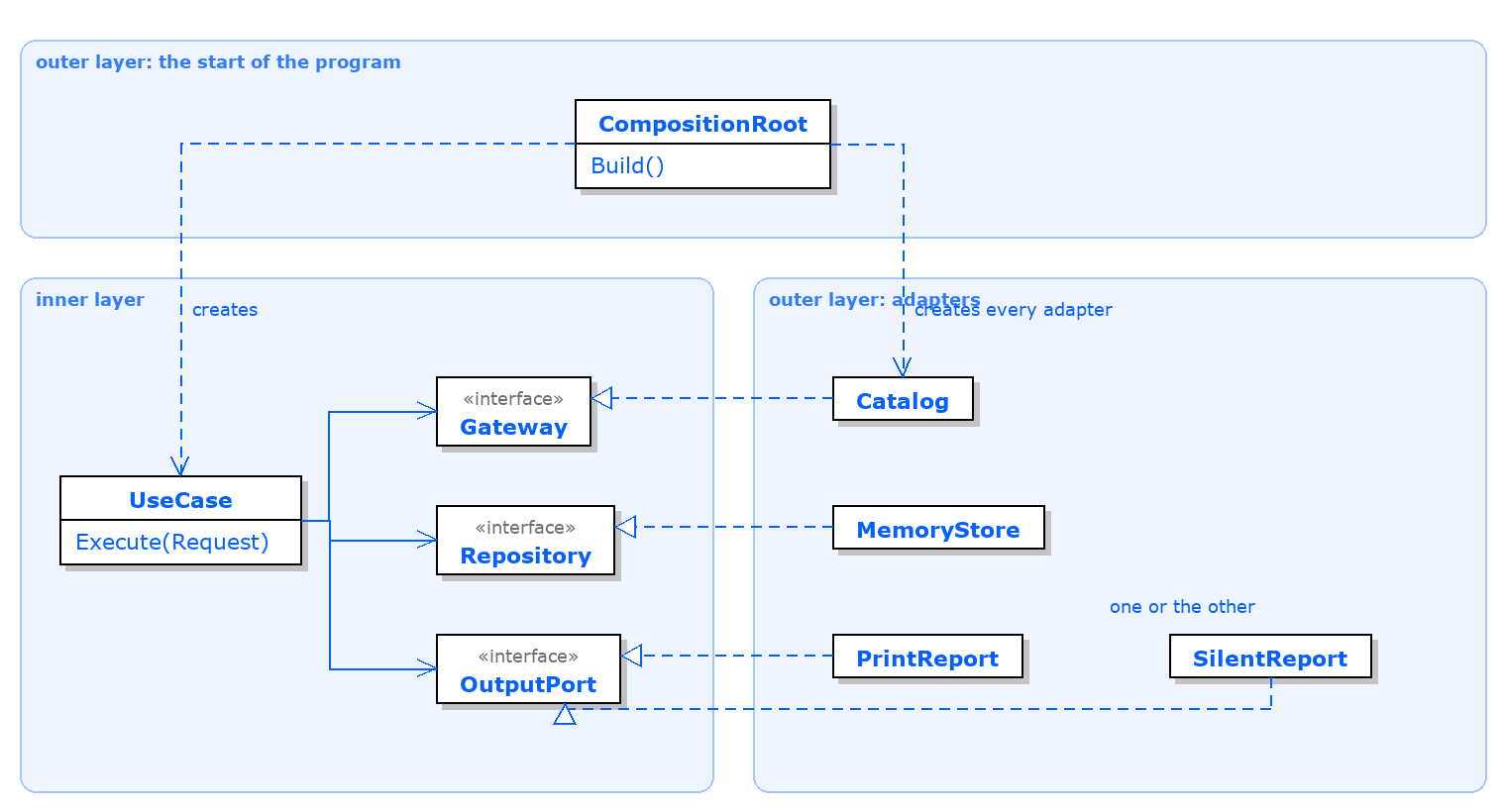
A composition root is the only place where the layers are connected and the adapters are built; the rest of the application only asks for its parts.Read more问题。用例需要一个价格目录、一个订单存储,以及一种报告结果的途径。如果用例自己创建这些部件,它就会指明外层的适配器,并依赖于它们。测试也无法为它提供别的部件。如果程序的每个部分都自行构建自己的部件,就没有人能看清应用程序是如何连接起来的。 思路。组合根是唯一一个连接各层、构建适配器的地方。适配器是实现端口的外层代码,而端口是内层声明的接口。用例只通过端口索取自己的部件,从不自己构建它们。组合根同时了解每一层,这正是它的职责。其余所有代码都遵守依赖规则:内层代码从不了解外层代码。这不需要任何框架或容器:组合根就是程序启动处的普通代码。 如何阅读示例。用例索取三个端口:一个查询价格的网关、一个保存订单的仓库,以及一个用于报告的输出端口。外层为它们提供了适配器:内存中的目录和存储,一个会打印的报告,还有一个什么也不说的报告。示例把应用程序构建了两次。第一次构建中,报告会打印:客户端代码下了订单 1001,应付 225,又下了一个含未知商品的订单。第二次构建使用静默的报告,因此它的订单什么也不打印。只有已保存订单的数量表明它们确实被保存了。两次构建中的用例完全相同。 何时使用。每个应用程序都有一个组合根,位于它的启动处;测试可以有自己的小型组合根,使用假的适配器。没有端口的短脚本不需要组合根。 常见错误。在用例内部创建适配器,哪怕只有一次。这样用例就依赖于外层,组合根也不再能展示应用程序是如何连接起来的。 |